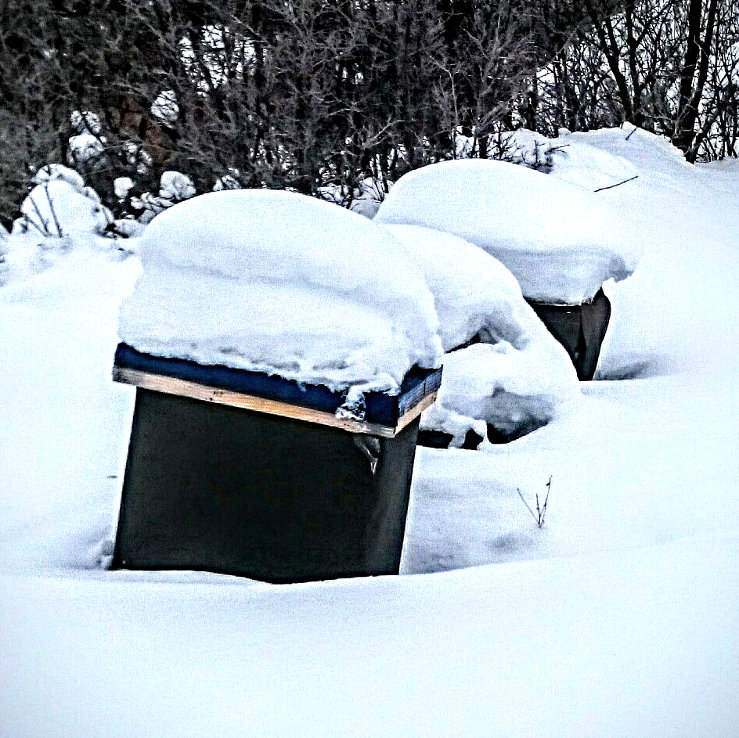
Some of my hives got a late start last season, and some of them I started late. Despite fall feeding, many were a little light going into winter. It’s been cold lately, but temperatures are forecast to be above average in January and February. I wasn’t sure how that would impact colony food reserves. For those with similar concerns, what follows is a summary of the research, as I understand it.
Honey bees evolved differently than most insects in the development of a social structure. This led to differences in their overwintering technique. Where most insects hibernate, honey bees remain active by clustering together to trap the heat produced by their metabolism. As outside temperature drops, the outer shell becomes more compact. At the less dense interior, a portion of bees vibrate their flight muscles to produce additional heat and compensate for any that escapes.
All of this clustering and heat production requires energy, which is sourced from stored honey. As outside temperatures decrease, the bees’ metabolism increases as they work harder to stay warm. With adequate honey available, a healthy cluster of 15,000 bees can maintain a core temperature of 95°F indefinitely at more than 20°F below zero. This is why you may have heard that bees don’t freeze to death, they starve.
There is, of course, a limit to this simple formula. When the temperature is warm enough for bees to break cluster, energy demand begins to rise again. The pivotal temperature is around 50°F. Ambient temperature inside a standard Langstroth hive is only a few degrees warmer than the outside air. Therefore, average daily temps of 40–45°F should keep the colony loosely clustered, resulting in minimal demand for heat/energy/honey.
All other factors being equal, a mild winter should help colonies stretch their food reserves. This has implications in the decision to wrap or otherwise insulate hives, since reducing the effect of cold reduces the need for honey (below 50°F). At the same time, warmer temps are likely to help stimulate early winter brood rearing, which then increases honey consumption (and facilitates mite reproduction). Every benefit comes at a cost. Smaller colonies are less efficient, consuming more honey per bee than larger ones. Special consideration should be given to the insulation of small hives in an effort to maximize reserves.
In a broodless winter cluster, bees have been observed at very low metabolic rates caused by hypoxia. Minimal additional heat is produced in the absence of brood, and cluster temperature is allowed to drop considerably. The bees can become so compact that ventilation is severely restricted, causing a shortage of oxygen and excess CO2. If the thorax temperature of a honey bee falls below 40°F, she becomes immobilized in a state of torpor known as chill coma. Unless warmed by an external source of heat, death comes in a few hours or a few days.