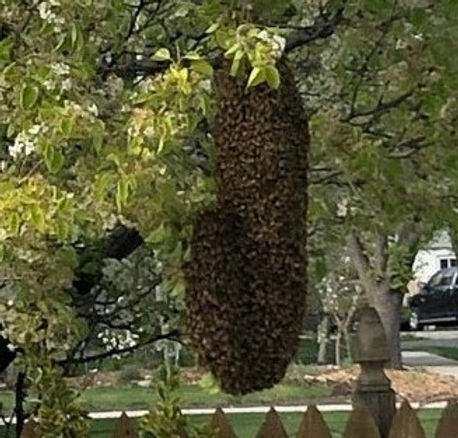
It takes less than nine days for a colony to produce a capped queen cell, so one inspection per week in the springtime is enough to prevent your bees from swarming. An inspection every two weeks is enough to keep you from knowing they did.
Consider a colony of 30,000 workers having a queen that lays 1,500 fertilized eggs per day. She stops laying for three days then departs in a swarm with 60% of the population. Here is what you will find upon inspection one week before the swarm:
- population — 19,500
- capped (pupae) — 18,000 (1,500 eggs/day × 12 days capped)
- uncapped (larvae) — 9,000 (1,500 eggs/day × 6 days uncapped)
- eggs — 4,500 (1,500 eggs/day × 3 days as egg)
This colony will lose roughly 2% of its population naturally every day (about 60 bees). We will ignore that, along with a variety of other factors, in order to keep this somewhat simple. Capped queen cells are the indication the colony has already swarmed, or that swarming is imminent.
- pop (pre swarm) — 30,000 (1,500 eggs/day × 7 days + 19,500)
- pop (post swarm) — 12,000 (30,000 less 60%)
- capped (pupae) — 18,000
- uncapped (larvae) — 9,000
- eggs — 0 (she stopped laying 3 days earlier)
Not laying for three days will have no impact on the population until the time comes that such brood would have emerged. In the meantime, the population will continue to grow at a rate of 1,500 per day until the end of the final brood cycle, or three weeks after the last egg was laid.
- population — 22,500 (1,500 eggs/day × 7 days + 12,000)
- capped (pupae) — 16,500 (1,500 × 11 days remaining in brood cycle)
- uncapped (larvae) — 0 (all have been capped)
- eggs — 0 (all have hatched)
So, one week after swarming, the population is already greater than it was one week before swarming! This is despite losing sixty percent of the workers! The population is replenished at the queen's maximum egg-laying rate, which she maintains only for a relatively short time at the height of colony expansion in spring. The amount of brood in the hive is a snapshot of the recent but past performance of the queen. Again, there are factors being omitted here. For example, the impact of after-swarms has not been calculated, but even if 5,000 bees did depart in a secondary swarm, the population would be about the same as it was two weeks prior. Also, the queen would still be unmated at this point, so she isn't likely to be found.
This is the scene just one week after a colony swarms: can't find a queen, there are no eggs and no larvae. Confusingly, this is exactly what you will find if your queen was recently killed. It's counterintuitive to think your colony swarmed when the population appears fully intact. And it's counterintuitive to think your colony is queenright when you can't find the queen and there are no eggs or larvae. But it's precisely what you will find a week after the colony divides. The answer might be found in the existence and condition of any queen cells that may still be present.
- population — 39,000 (22,500 + 16,500 remaining pupae emerge)
- capped (pupae) — 0
- uncapped (larvae) — 0
- eggs — 0
- some drone brood yet to emerge
The mystery deepens. If you inspect your colony 2½ weeks after it swarms, you just might lose your ship. You won't find any worker brood, no eggs or larvae and probably not even your freshly mated queen. The population will be much larger than it was before so you won't think for a second they swarmed. The only thing you'll find is some sporadic drone brood that has yet to emerge, because drones take three days longer to develop than workers. Your colony will have every appearance of a laying worker colony, unless you're lucky enough to spot the young queen who has yet to begin laying. Likely far removed from your mind is the reality that all is totally fine and on its proper course.
It literally pays to be patient when a colony appears to be queenless in spring. The risk of dropping fifty bucks on a mated queen you don't need is high, while the likelihood of accidentally losing the one you have is low. Think about the resilience of a queen bee. One of the interesting symptoms of late-stage collapse is her continued presence in the brood nest amid a rapidly depleting cohort of young nurses. She can very often be found at the center of a small winter cluster that froze on the comb. She's one of the last to die or get sick, because she is so well protected. She even survives supersedure until the colony totally neglects her. She survives in the confines of a queen cage as her attendants slowly die, and her normal lifespan is many times that of a worker.
Unless a queen is rejected by the colony or you kill her yourself, she probably isn't dead. And if it looks like they haven't swarmed because there's just as many bees as there was before, it probably means they have. Otherwise you would be standing ankle-deep in honey bees. The population would be way bigger than before. Easier said than done, but be patient when you can't find eggs or a queen at the height of spring. It's often the indication that everything is normal.