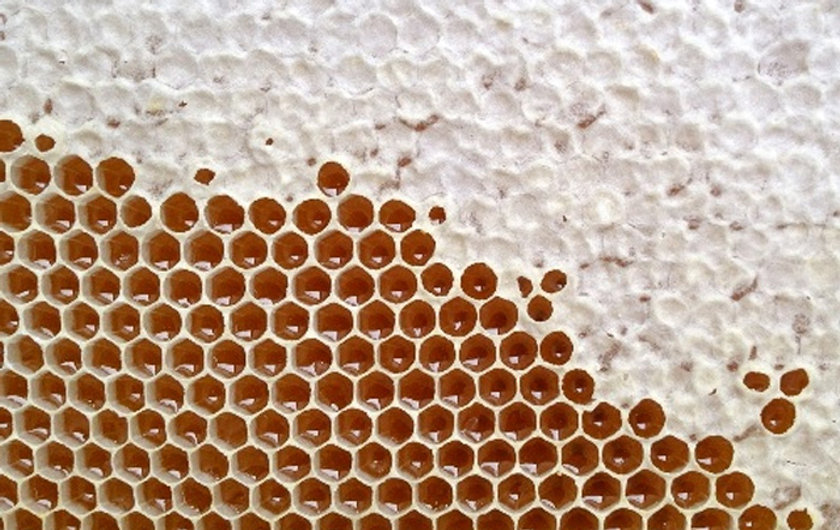
Most beekeepers are aware that honey is hygroscopic, which describes a material that absorbs moisture from the surrounding air. More accurately, it exchanges moisture with the surrounding air. Water may be gained or lost, depending primarily on the relative humidity. A hygroscopic material seeks to reach moisture equilibrium with its environment, at which point water content stabilizes.
The honey bee brood nest is a rather dry place, despite the requirement of nearly 100% humidity for eggs to hatch. The remainder of the brood area experiences between 50 and 60% relative humidity, regardless of local climate. Beyond the highly regulated conditions of the brood nest, hive humidity trends toward equilibrium with the outside air.
Salt Lake City consistently ranks as one of the four driest major cities in America. Average year-round relative humidity is 55%, matching that of the honey bee brood nest. Average afternoon humidity during summer drops to 25%. Unlike most parts of the country, Utah is dryer than a beehive.
At 17% moisture and below honey will not ferment, because the naturally occurring yeasts cannot grow. At 18% moisture there is a low risk of fermentation. At 19% and above, fermentation of honey can be expected. That honey never spoils is mythological.
At 55% relative humidity (RH), the average found in the brood nest, honey has a water content of 17% when in equilibrium with the surrounding air. Even when uncapped, it will not ferment. Beyond the boundary of the brood nest, at RH levels above 60%, equilibrium moisture content of honey rises above 18% and is at risk of fermenting. Uncapped honey stored above 60% RH will absorb water from the surrounding air and eventually ferment.
But what if the prevailing RH is lower than 60%, as is the case along the Wasatch Front in the summertime? The average summertime humidity in Utah is 40%, which translates to an equilibrium moisture content of 15%. Such honey will probably be extracted and jarred in less time it takes to reach equilibrium, resulting in a moisture content somewhere between 15% and 18%. Leave the lid off a jar of honey long enough in summertime, and even ripened honey will slowly thicken as it gets further dehydrated.
So why do workers bother capping honey at all? First, there already exists a need to dilute honey with water for winter consumption. More importantly, by late October or early November humidity levels along the Wasatch Front begin to rise above 60%, putting uncapped honey at risk of spoilage.
In Utah, honey does not absorb moisture during the summertime. The possibility of fermentation is extremely low. Whether it remains in the hive or is pulled for harvest, the moisture content of uncured honey will passively decrease to safe levels as it moves toward equilibrium with the surrounding air.
The average moisture content of honey produced in the Intermountain West is 16%, the lowest in the country. If that batch of honey is a little high on moisture, just let it sit uncovered in a protected area for several days. It will slowly dehydrate on its own. The passive summertime evaporation of water from Utah honey makes life a little easier on bees and results in a more concentrated, thicker product that is unique to the region and among the best honey available anywhere.