Ask ten beekeepers how to ventilate the hive in winter, get one answer. Something’s not right. Does adding ventilation holes at the top of the hive overcompensate for moisture? Having evolved in the warm, wet hollows of a tree cavity equipped with a single, small entrance at the bottom (Seeley 1976), Apis mellifera is likely not a stranger to mold. Its presence in the hive is well tolerated, and does not cause the colony to dwindle in winter or produce less honey in spring (Fries 1982). And although the threat of condensed water icing the cluster is real, such a phenomenon is reserved for extreme circumstances (Gates 1914).
Ventilating the top of the hive allows warm, wet air to escape, and we justify this sacrificial loss of heat on the popular myth that cold doesn’t kill honey bees. In actuality, it is the colony’s remarkable ability to stay warm that it can survive winter at all. Condensed water is a problem because it’s cold water. It chills the bees. Cold absolutely kills honey bees, and any hive modification that draws heat away from the winter cluster should be met with a healthy dose of hesitation.
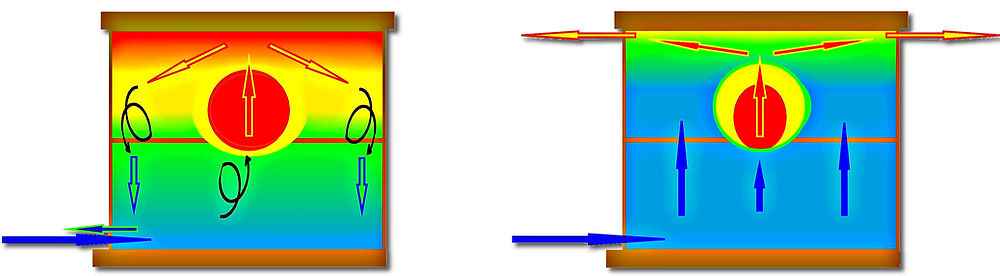
The efforts of thermoregulation are intended to heat the cluster, not the hive interior (Stabentheiner 2003). As fresh, outside air flows in through a narrow, inch-wide bottom entrance, it mixes with escaped heat in the space below the cluster. It isn’t the nature of cold air to rise — it has to be heated first. Provided the hive is protected from the wind and free of upper vent holes, air at the bottom only rises when its temperature increases above that of the surrounding air (Sudarsan 2012).
With the lower hive area acting as a heat exchanger, preheated air penetrates the cluster and displaces warmer, humid air within. When the flow reaches the hive ceiling, it mushrooms outward and downward into the cooler air below. Without upper ventilation, 98% of condensation takes place below the cluster (Toomemaa 2013). That’s because air has to cool before it can release water, and the coolest air is on the bottom.
Ventilating the top of the hive replaces this circular flow with a wind tunnel effect, subjecting the cluster to a continuous one-way stream of cold, outside air. This undoubtedly keeps the hive dry, but also increases cold stress, forcing the cluster to work harder to stay warm. Colony metabolism must then increase, fueled by an increase in honey consumption, which results in greater amounts of water in the hive. Other problematic consequences include reduced humidity in the brood nest (eggs less likely to hatch, higher mite reproduction) and dilution of pheromones (Erickson 1990).
In the end, several thousand healthy bees with a plentiful supply of honey and minimal protection from the elements will survive winter, with or without the beekeeper. But they will struggle. Their mere survival should not be indicative of an ideal winter setup. Take all the information you gather, including what you read in this blog, with a measure of skepticism.
“…ventilation draws moisture from the cluster, stressing the bees by causing them to step up the metabolism of honey to maintain both temperature and humidity… Several studies have shown that honey bees can compensate for and survive temperature extremes. However, what such studies have not considered is the drain on the physiological resources of the colony. The effects of this stress may well be significant in terms of reduced brood rearing or foraging and shortened worker bee life span.”— Eric H. Erickson, Stress and Honey Bees