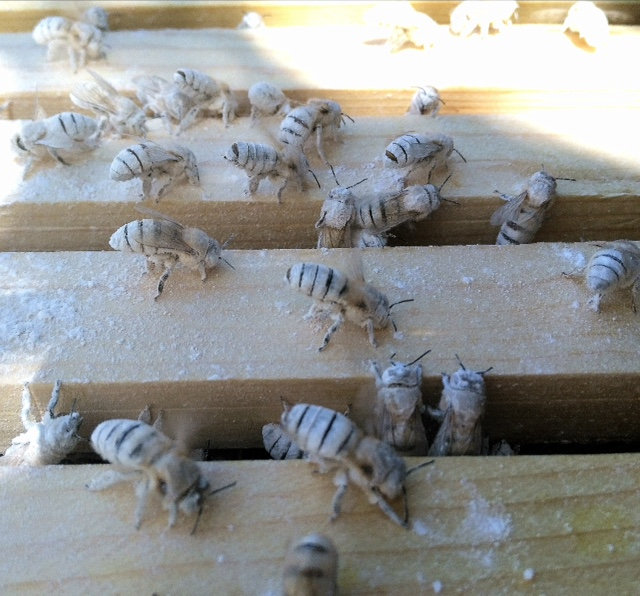
The unreliability of sticky boards and the dead bee effect of an alcohol wash has beekeepers doing the sugar shake. It works by tossing a half cup of bees (approx. 300) in a jar of powdered sugar to dislodge mites. Then you count them. This is supposed to give the beekeeper a fairly accurate estimate of the infestation level so a decision can be made on treatment. There’s been some indication, however, that the sugar roll has failed to adequately warn beekeepers of an impending mite problem.
A highly circulated instructional poster created by the University of Minnesota has been published or linked on many beekeeping sites. However, its advice is dangerously permissive:
If there is brood in the colony when you sample, you should double this [mite] number to factor in the amount of mites in worker brood. For example, if there are 5 mites / 100 bees, the total infestation is probably 10 mites/100 bees. If your colony has over 10-12 mites/100 bees, you should consider treatment.— University of Minnesota
Unfortunately, with every good intention, this particular U of M document is likely to establish your colony firmly on the road to disaster. Waiting for infestation levels to climb above 10% before issuing any recommendation to even consider treatment is a big mistake. Fifteen mites in the sugar jar ought to be a clear indication that treatment is overdue. For a colony of 40,000, it means 4,000 mites in the hive. Colonies have collapsed with far less.
Treatment parameters published by The Honey Bee Health Coalition are far less tolerant, with thresholds ranging from 1–5%. UDAF recommendations call for a maximum infestation of 3% at any time. Randy Oliver of scientificbeekeeping.com shows that a colony beginning the year with 100 mites can show just a 1% infestation on an August alcohol wash — yet collapse in October with over 5,400 mites.
The failure of the sugar shake to detect a deadly mite infestation is largely a function of brood in the hive. There’s no way of knowing how many mites are under the brood caps. Simply doubling the mite count is inadequate because there are too many variables. With barely any brood, most mites will be attached to nurse bees (phoretic) and easy targets for a shake. But if you uncover three mites with lots of brood in the hive, you’re totally in the dark.
The sugar shake is so full of uncertainty, and so subject to user technique, that the margin of error is likely greater than the treatment thresholds. At best, you waste your time. At worst, the test gives you a false sense of security, so you do nothing and lose your bees. When it comes to the Varroa mite, don’t sugar coat it. Just treat.